How Melt Gear Pumps Eliminate Extruder Pressure Fluctuations?
Pressure fluctuations in extruders have long been a nightmare for manufacturers of plastics, rubber, and composite materials. These unpredictable fluctuations not only compromise product quality—leading to uneven thickness, surface defects, and inconsistent mechanical properties—but also result in costly downtime, material waste, and reduced production efficiency. For operations that rely on precision extrusion processes—from film blowing and pipe extrusion to profile manufacturing—finding a reliable method to curb pressure instability is critical. This is where melt gear pumps come into play: these specialized components are designed to eliminate extruder pressure fluctuations at their source, delivering unmatched stability and performance.
Melt gear pumps work on a simple yet highly effective principle: positive displacement. Unlike traditional extrusion systems that rely solely on the extruder screw to push molten material, a melt gear pump is installed between the extruder and the die. It features two interlocking gears that rotate in opposite directions, creating a constant volumetric flow rate. As molten material (melt) enters the pump’s inlet, the gears trap and carry it to the outlet, delivering a consistent, pulsation-free flow regardless of upstream pressure variations. This positive displacement action acts as a “pressure regulator,” smoothing out any fluctuations caused by factors like inconsistent material viscosity, screw wear, feed rate variations, or temperature changes.
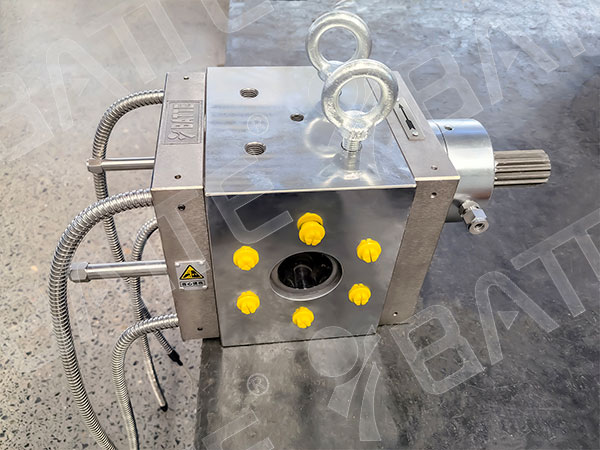
One of the key reasons melt gear pumps excel at eliminating pressure fluctuations lies in their ability to decouple the extruder from the die. In conventional extrusion setups, the extruder must compensate for die pressure changes, leading to unstable flow. With a melt gear pump, the extruder’s primary role becomes feeding the pump at a constant rate, while the pump takes full control of delivering the melt to the die at a precise pressure and flow. This separation ensures that even if the extruder experiences minor pressure spikes or drops, the pump absorbs these variations, preventing them from reaching the die and affecting the final product.
To maximize the pressure stabilization effect, high-quality melt gear pumps are engineered with tight tolerances and advanced materials. The gear teeth and pump housing are typically made from wear-resistant alloys (such as nitrided steel or stainless steel) to minimize internal leakage, ensuring consistent volumetric efficiency. Additionally, precision machining guarantees that the gears mesh perfectly, reducing flow pulsations to near-zero levels. Many modern melt gear pumps also come with integrated pressure and temperature sensors, allowing for real-time monitoring and automatic adjustments to maintain optimal stability.
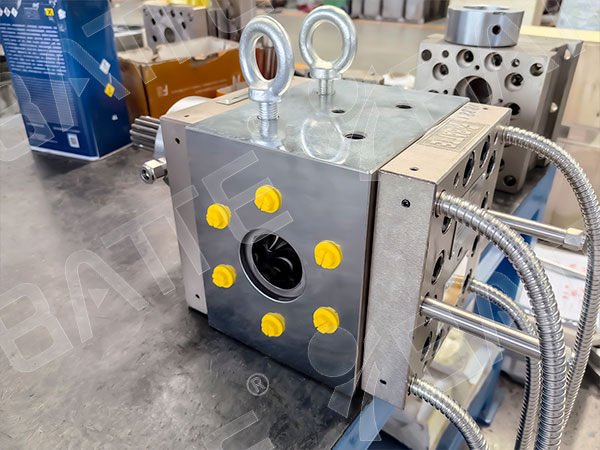
The benefits of using a melt gear pump to eliminate extruder pressure fluctuations extend far beyond improved product quality. Stable pressure and flow translate to reduced material waste, as manufacturers no longer have to discard off-spec products caused by uneven extrusion. Downtime is also minimized, as consistent operation reduces the need for frequent die cleaning or machine adjustments. Furthermore, melt gear pumps enhance energy efficiency: by reducing the extruder’s workload (it no longer needs to fight die pressure), power consumption can decrease by 10-20%, lowering operational costs.
Melt gear pumps are versatile and suitable for a wide range of extrusion processes and materials. Whether processing polyethylene (PE), polypropylene (PP), PVC, engineering plastics (such as ABS or PC), or even high-viscosity materials like rubber or composites, a properly sized melt gear pump can deliver reliable pressure stabilization. They are commonly used in film extrusion (cast film, blown film), sheet extrusion, pipe and profile extrusion, fiber spinning, and compounding applications—proving their value across diverse manufacturing scenarios.
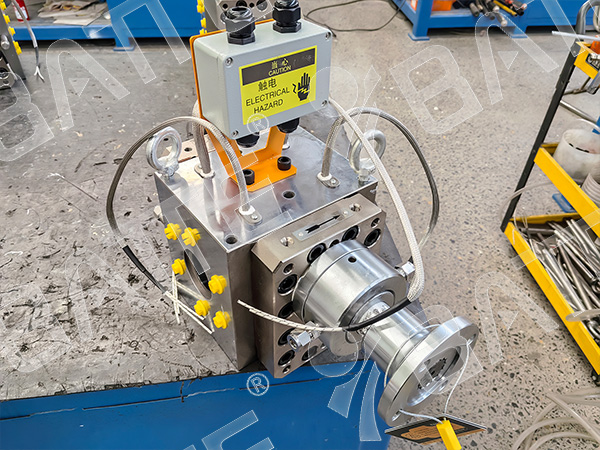
When selecting a melt gear pump to eliminate extruder pressure fluctuations, several factors should be considered. The pump’s flow rate must match the extruder’s output capacity, while the pressure rating should exceed the maximum die pressure required for the application. Material compatibility is also crucial: the pump’s construction materials must withstand the temperature and chemical properties of the molten material. Working with a reputable manufacturer ensures that the melt gear pump is customized to your specific extrusion line, maximizing its performance and longevity.
In conclusion, extruder pressure fluctuations no longer have to be an inevitable challenge. Melt gear pumps offer a proven, efficient solution to 根治 (eliminate) these variations, leveraging positive displacement technology to deliver consistent pressure and flow. By decoupling the extruder from the die, minimizing internal leakage, and ensuring precise flow control, melt gear pumps enhance product quality, reduce waste and downtime, and lower energy costs. For manufacturers seeking to optimize their extrusion processes and gain a competitive edge, investing in a high-quality melt gear pump is a strategic decision that delivers long-term returns. Say goodbye to pressure fluctuations and hello to stable, efficient extrusion with melt gear pumps.
Email: sale@meltpump.com
WhatsApp: +86 158 3833 1071